After years of designing, fabricating, and installing signage across Connecticut, I’ve learned that the sign on your building does more selling than most of your staff. It works around the clock, never calls in sick, and forms a customer’s first impression before they’ve even parked the car. Yet I still walk into consultations where a business owner has no idea which building sign actually fits their storefront, their budget, or their local zoning code. That’s what I want to clear up here.
What Counts as a Building Sign?
A building sign is any sign that’s mounted directly to a structure rather than freestanding in the ground — think wall-mounted letters, illuminated cabinets, awning graphics, and window lettering. They’re different from pylon signs or monument signs, which sit on their own base near the road. Building signs are your primary storefront identifier, and for most retail, medical, and professional service locations in New Haven and across Connecticut, they carry the heaviest branding load of any signage you’ll own.
Understanding the different types of business signs available — and matching them to your building’s architecture and your customer’s sightlines — is the difference between a sign that gets noticed and one that blends into the block.
The Main Types of Business Signs for Buildings
Channel Letters
Individual, dimensional letters — either illuminated or non-illuminated — mounted directly to a wall or parapet. Channel letters are what most people picture when they think of a modern storefront sign: clean, three-dimensional, and legible from a distance. I recommend these most often to retail tenants in strip centers and downtown storefronts because they read well both day and night, and they photograph well for a business’s own marketing.
Illuminated Cabinet Signs
A cabinet sign is a boxed unit with internal lighting, typically used where a business needs a single large format piece rather than individual letters — think pharmacy chains, auto shops, and fast-casual restaurants. Cabinet signs are budget-friendly per square foot and hold up well in weather, though they don’t have quite the premium look of channel letters.
Monument and Building-Mounted Combo Signs
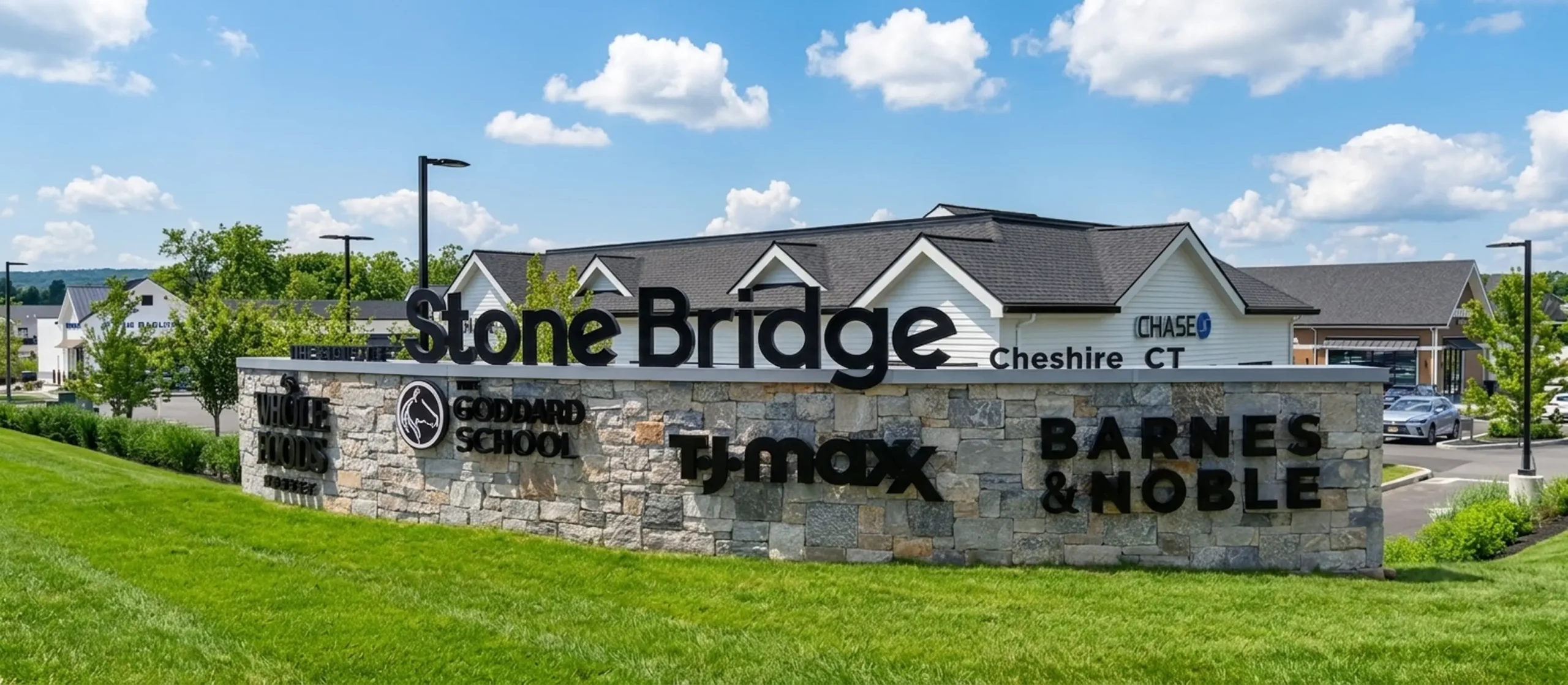
For properties set back from the road, a monument sign near the sidewalk paired with a smaller building-mounted identifier gives you visibility at both driving and walking speed. This combination works especially well for medical offices, law firms, and multi-tenant buildings along Connecticut’s commercial corridors, where a single sign type rarely covers both audiences.
Dimensional and Halo-Lit Letters
Halo-lit (or “reverse-lit”) letters glow around their edges rather than through their face, giving a business a more upscale, architectural look. I use these for boutique retail, hospitality, and any brand that wants their storefront sign to feel premium rather than purely functional. They cost more than standard channel letters but the visual impact is worth it for the right storefront.
Window and Awning Graphics
Not every building allows large-format wall signage, especially in historic districts around New Haven. Window lettering, vinyl graphics, and awning signage let a business establish presence without altering the building facade — often the only option that satisfies both a landlord’s lease terms and local sign ordinances.
Matching Sign Type to Storefront Sign Strategy
The right storefront sign depends on three things: how fast traffic moves past your location, how far back your building sits from the road, and what your lease or local code actually permits. A restaurant on a fast-moving Connecticut arterial road needs bold, high-contrast channel letters visible at 40 mph. A boutique on a walkable downtown block can lean into detailed dimensional letters or hand-painted window graphics that reward a closer look. I walk every client through this before we sketch a single concept, because a beautiful sign that’s unreadable from the road — or that violates a permit requirement — isn’t doing its job.
Materials and Durability
Aluminum, acrylic, and PVC dominate building sign construction because they hold paint and vinyl well and resist New England’s freeze-thaw cycles. For illuminated signs, LED modules have replaced neon and fluorescent tubing almost entirely — they run cooler, last longer, and cost less to operate over the sign’s lifespan. When I spec a building sign for a Connecticut client, weather resistance and long-term maintenance cost matter as much as the initial design.
Permits and Local Sign Codes
Every town in Connecticut, from New Haven to the surrounding suburbs, has its own sign ordinance covering size, illumination, and placement. Historic districts add another layer of review. This is the step where DIY signage projects most often stall out or get flagged after installation. I handle sign design and permitting together for exactly this reason — a sign that looks great on paper but doesn’t clear local code isn’t a finished project, it’s a liability.
From Concept to Installed Sign
A building sign project runs through three distinct phases: design, fabrication, and installation. I’ve seen businesses try to split these across different vendors and end up with mismatched colors, delayed timelines, or a sign that was fabricated to different specs than what was designed. Handling sign fabrication and sign installation under one roof keeps the specs consistent from the first sketch to the final mount, and it’s the approach I’d recommend to any business owner comparing sign companies.
What I’d Recommend for Your Building
If you’re weighing building signs for a New Haven storefront or a location anywhere in Connecticut, start with your building’s architecture and your customer’s approach speed, not with a catalog of sign styles. From there, the type of business sign — channel letters, a cabinet sign, halo-lit dimensional letters, or a monument-and-wall combination — should fall out naturally.
I’d be glad to walk your building’s facade and lease terms with you and put together options that fit your budget and your local sign code. You can look through examples of past work in our custom signage portfolio or hear directly from other Connecticut business owners on our testimonials page. When you’re ready to talk specifics, reach out to the SIGNLite team and we’ll schedule a walkthrough of your building.